Fireplace Integration
Media Walls With an Integrated Fire
Electric and bioethanol fires supplied and built into the wall as part of the structure — not sat in front of it. Designed and installed across Cumbria and the Lakes.
Electric and bioethanol fires supplied and built into the wall as part of the structure — not sat in front of it. Designed and installed across Cumbria and the Lakes.
A fire that has been added to a media wall afterwards always looks added. The proportions do not quite line up, there is a shadow gap where there should not be one, and the heat has nowhere sensible to go. Building the fire in from the start solves all three at once.
The recess is sized to the specific unit, with the manufacturer's clearances designed in rather than hoped for. The screen sits above at a height that works for the seating, with the heat output routed away from it. And the whole face reads as one piece, because it was drawn as one piece.
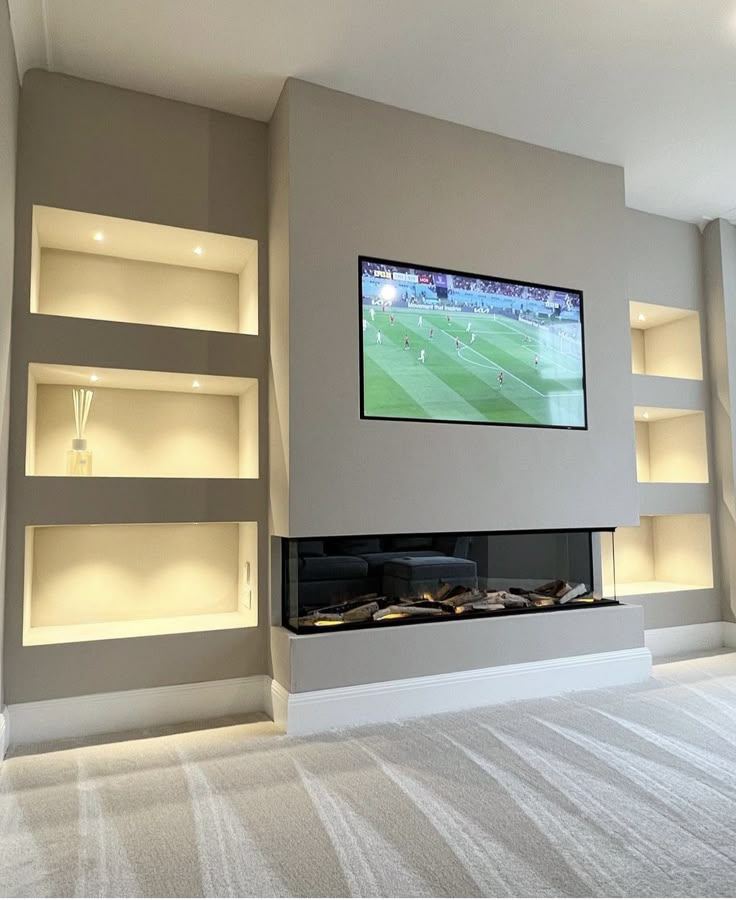
An electric fire produces a flame effect with LEDs and usually an optional heater, needs a mains spur, and comes in the widest range of sizes — it is what most media walls use. A bioethanol fire burns liquid fuel and produces a genuine flame with real heat, needs no flue and no electrical supply at all, but has to be refuelled by hand and needs the room ventilated. Bioethanol is the answer when getting power to the spot would mean lifting floors.
Yes, when it is designed for. The risk is heat rising into the screen, so the fire's own clearance specification governs the gap, and the recess is built with ventilation that carries warm air out at the front rather than up behind the panel. Electric fires make this straightforward because output is low and controllable. It is precisely the detail that goes wrong when a fire is retro-fitted into a wall that was not planned around it.
Most need a dedicated fused spur rather than a full new circuit, though it depends on the unit's load — larger fires with high heat output can need more. That gets confirmed against the specific model at design stage and the work is done by a certified electrician as part of the build.
No, which is the main reason people choose them. They burn cleanly enough to run without a flue. They do still need adequate room ventilation, they must be refuelled by hand when cool, and they should never be moved or refilled while lit — we will go through the practicalities before you commit, because they suit some households far better than others.
Yes, and it is a common part of the job. A gas appliance must be disconnected and capped by a Gas Safe registered engineer — that is a legal requirement, not a preference — after which the opening is made good and the new build goes in. We arrange it as part of the project.
Get in touch for a free, no-obligation consultation. We will talk through electric versus bioethanol and what suits your room.